

Tell Disney what scares you, and it tells you when it’s coming. That’s the idea behind a new patent from Disney Enterprises, describing a system that lets guests flag personal ride fears and then warns them right before those exact moments happen.
Quick Summary
- The patent published August 20, 2026
- Guests flag personal “aversions” — flashing lights, drops, tight spaces
- The system matches those against data the ride broadcasts
- Warnings can arrive before you ride or mid-attraction
- Effects could potentially be dialed down on request
- An intensity rating scale from 1 to 5 or 1 to 10 is described
- It also works in reverse for things you enjoy
Who Filed It
The patent was filed by Disney Enterprises and published August 20, 2026. The listed inventors are Gregory Brooks Hale, Celia Gomez, and Reshmashree Bangalore Kantharaju.
The filing describes a personalized attraction notification system built around what it calls “aversions” and “preferences.”
How It Works
You tell the system what bothers you — flashing lights, tight spaces, sudden drops, dark scary scenes.
The system stores that in a preferences database tied to your profile.
Then, when you’re near or inside an attraction, it compares your list against data the ride itself broadcasts describing its content.
If there’s a match, you get a warning before that moment hits.

Why Current Warnings Don’t Work Well
The filing is unusually direct about the shortcomings of how parks handle this today, and the reasoning is sound.
Right now Disney does what every park does: a sign near the entrance, or a recorded audio message before you board.
The patent identifies three specific problems:
- Length. A sign or audio track can only list so much before it becomes impractical to read or hear in full. List every possible trigger and guests have to comb through it to find their specific concern.
- Deterrence. A long warning list discourages people from riding at all — even when only one item on it actually affects them.
- Maintenance. Every time a ride’s effects change, or a new concern is identified, the sign or audio needs updating. That’s slow and costly to keep current.
- The core difference: instead of one generic list every guest sorts through, this surfaces only what applies to what you personally flagged.
The Deterrence Point Is the Strongest Argument
That middle problem is the one worth sitting with, because it cuts against how most people assume warnings work.
A comprehensive warning sign can reduce ridership among people who would have been fine. Someone who dislikes sudden drops reads a sign listing drops, darkness, loud noises, flashing lights, and simulated falling, and walks away — even though only the drops were relevant and this particular ride’s drops are mild.
Personalisation solves that in both directions. It flags genuine concerns more reliably while removing the noise that scares off guests unnecessarily.
That’s a real accessibility argument, and it’s the strongest case for the technology.
What the System Could Actually Do
The patent lays out several possibilities:
- Get alerted while you’re still deciding whether to ride, based on your location near the attraction
- Get a real-time warning right before a specific scene or effect — a sudden 20-foot drop, for instance — is about to occur
- Receive substitute content in place of an aversive element, where the ride supports it
- Have the system request the ride’s controls dial an effect down — lowering volume, or reducing how abrupt a motion effect feels

The Effect-Modification Idea Is the Ambitious One
Warnings are software. Actually changing what a ride does for an individual guest is a different order of problem.
Volume reduction is plausible. Individual audio in a ride vehicle already exists — Rise of the Resistance, Mystic Manor, and others use vehicle-specific audio.
“Substitute content” is plausible on screen-based attractions where the imagery is projected or displayed rather than physical.
Reducing “how abrupt a motion effect feels” is where this gets genuinely difficult. Ride motion profiles are safety-certified systems. Varying them per-guest means either vehicles with individually adjustable motion — which few attractions have — or dialing down the effect for everyone in that vehicle, including guests who came for exactly that sensation.
A drop tower that drops less because one rider requested it is a worse ride for the other twenty people on it. The patent doesn’t obviously resolve that tension.
The Intensity Rating Scale
The filing describes a rating scale — one to five, or one to ten — for how intense a particular effect is within an attraction.
So a guest with a mild aversion to flashing lights might still ride if the intensity is low, while someone with a stronger aversion gets a heads up regardless.
This is the most immediately useful piece of the whole filing, and it doesn’t require any of the harder engineering.
Right now, warnings are binary. A ride either has flashing lights or it doesn’t. There’s no distinction between a brief strobe in one scene and sustained flashing throughout.
A numerical scale would let guests calibrate. That’s genuinely valuable for anyone managing photosensitivity, claustrophobia, or motion sensitivity — conditions that exist on a spectrum rather than as on-off switches.
It Also Works in Reverse
The system isn’t only built for aversions.
You could flag things you enjoy — a love of sharp turns or fast drops — and the system could point you toward attractions matching what you want.
That’s the commercially interesting half, and it’s worth being clear-eyed about. A system that knows your preferences and recommends attractions is, functionally, a recommendation engine sitting inside a park app. The accessibility case is genuine; so is the merchandising and routing potential.
Could This End Up in My Disney Experience?
The patent doesn’t name a specific app, and Disney hasn’t said anything public about building this into My Disney Experience.
But the diagrams show a smartphone-based system with a GUI, location tracking, and a display — functionally very similar to what My Disney Experience already handles for wait times, mobile order, and Lightning Lane.
If Disney builds this, My Disney Experience is the logical home, since it already ties into guest profiles and location data.
The Privacy Question Nobody Has Answered
Worth raising, because the article doesn’t and it matters.
A database of guests’ personal fears and phobias is sensitive data. Claustrophobia, photosensitivity, anxiety around darkness or confinement — some of these overlap with medical conditions.
Disney hasn’t described how such data would be stored, retained, or used, because a patent application isn’t the place for that. But anyone enthusiastic about this feature should want those answers before opting in.
The upside is real and so is the tradeoff. Both deserve stating.
The Usual Caveat
Patents describe what a company could build, not what’s coming next.
Plenty of Disney patents never make it past the filing stage. Disney typically doesn’t comment on unreleased technology tied to patent filings.
The Bottom Line
Disney has patented a system that stores guests’ personal ride aversions — flashing lights, drops, tight spaces, dark scenes — and warns them before those specific moments occur, with an intensity scale from 1 to 5 or 1 to 10.
It could also request effects be dialed down, offer substitute content, and work in reverse to recommend attractions matching what you enjoy.
No app has been named, and no plans to build it have been announced.
20% Off site-wide, plus Free Shipping on all orders of $65+
Over 75+ Designs! Your next park shirt is just a click away
Looking To Book Your Dream Disney Vacation?
Your Disney vacation should create unforgettable memories that last a lifetime.
Whether you’re a first-time Disney vacationer or looking to plan your next magical adventure, it isn’t enough just to go on a Disney vacation. We want you to talk about your vacation for years to come and create memories you’ll cherish forever. Vacation is calling! Are you ready to answer?


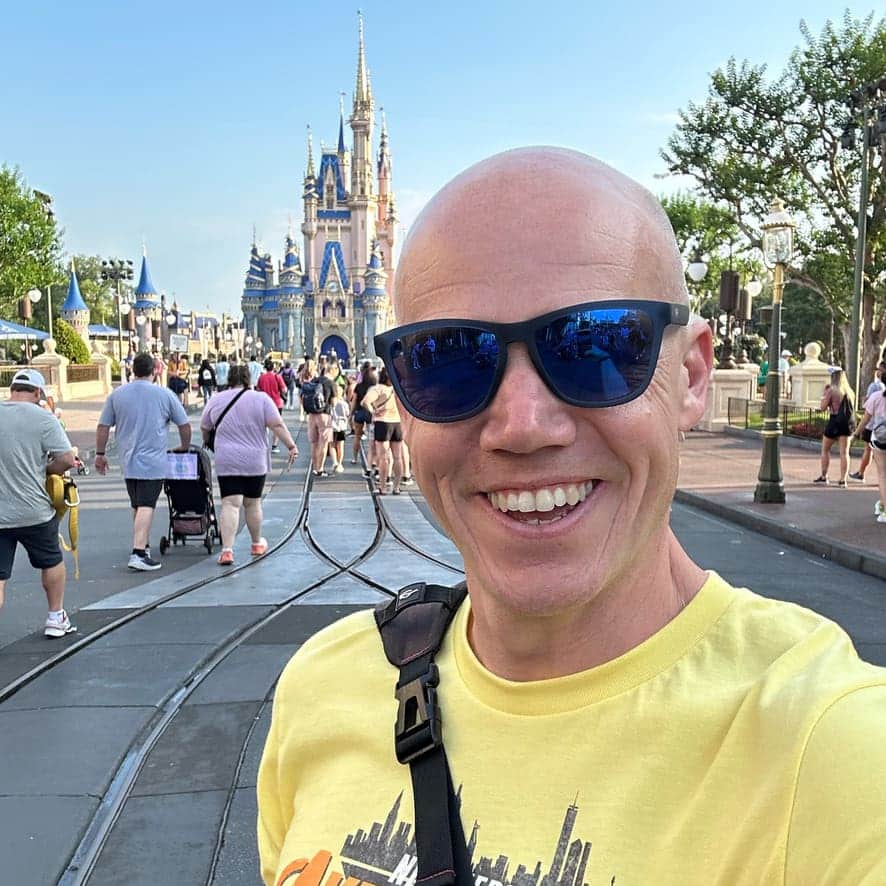
Meet the Author: Nate Bishop
I’m a die-hard Disney fan with 38 years of visits under my belt, having stepped into Disney World 120+ times. Proud to be a Disney Annual Passholder, a Vacation Club member since ’92, a Castaway Club Member, and a runDisney enthusiast. Oh, and I’ve graduated from the Disney College of Knowledge. Need Disney insights or planning tips? I’m your guy!
LAST UPDATED: