

“We’re certainly not discounting our way to volume growth.” That was CEO Josh D’Amaro’s answer when an analyst asked whether Disney’s recent park promotions signal softening attendance.
Disney held its earnings call for the third quarter of fiscal 2026, and D’Amaro and CFO Hugh Johnston gave more detail on what’s behind Walt Disney World’s strong quarter.
Here’s what came out of the D’Amaro Q3 earnings call.
Quick Summary
- Global guests grew 4% year over year; domestic park attendance rose 3%
- Per capita spending at domestic parks grew 4%
- Experiences segment revenue hit $10 billion, a record for a fiscal third quarter
- D’Amaro said new discount programs are targeted offers, not a response to weak attendance
- Toy Story now spans four immersive lands, 19 attractions, and two hotels
- The Mandalorian and Grogu underperformed at the box office but drove parks and retail
Attendance, Spending, and Where Growth Came From
D’Amaro expanded on the numbers from the earnings release:
- Global guests grew 4% year over year
- Domestic park attendance rose 3%
- Per capita spending at domestic parks grew 4%
He credited “strong domestic tourist and local resident growth” for the gains, and said that growth helped offset continued softness in international attendance — though he noted that softness has moderated recently.
He also pointed out that Experiences segment revenue hit $10 billion for the quarter, up 10% year over year, calling it a record for a fiscal third quarter.
Growth wasn’t limited to the parks. Disney Cruise Line expanded, with the Disney Destiny and Disney Adventure both performing well, and Disneyland Paris saw a boost from the opening of World of Frozen.
The Discount Question
One of the more pointed questions on the call came from an analyst asking about recent promotional pricing at the parks — including after-2pm pricing at Walt Disney World, Anaheim resident pricing at Disneyland, and a new evening access option.
The question: are these discounts a response to softer attendance?
D’Amaro said no. He described the promotions as targeted offers aimed at specific guest groups — value-focused visitors, local residents, or guests who want flexibility in when they visit — rather than a sign of broader weakness.
He pointed to per capita spending growth as evidence: with spending up 4% at domestic parks, he said, “we’re certainly not discounting our way to volume growth.”

Is That Answer Convincing?
Partly, and it’s worth being straight about which part.
The per capita argument is genuinely strong. If discounting were driving attendance, you’d expect per-guest spending to fall — more price-sensitive visitors spending less each. Instead spending rose 4% alongside 3% attendance growth. That’s not the signature of a discount-driven quarter.
But the promotions are real and they’re new. After-2pm pricing, resident pricing, and evening access options didn’t exist at this scale before. Companies introduce flexible pricing tiers when they want to fill capacity they aren’t otherwise filling.
The honest synthesis: both things can be true. Disney can be yield-managing specific low-demand windows — weekday afternoons, evenings, local markets — while overall demand and spending stay healthy. That’s sophisticated revenue management, not weakness.
The number to watch is whether per capita spending holds in Q4 as these programs mature.
Toy Story’s Reach Across the Parks
D’Amaro gave new detail on how deep the Toy Story franchise runs:
- The five Toy Story films have brought in more than $4 billion in global box office
- More than 2 billion hours streamed on Disney+
- Toy Story generates more than $1 billion in annual global retail sales across retailers
- The franchise now has a presence across four immersive lands, 19 attractions, and two hotels across Disney’s parks and cruise ships
That last figure is the one worth sitting with. Nineteen attractions across four lands and two hotels is an enormous physical footprint for a single franchise.
It also explains why Toy Story 5’s theatrical performance matters to the parks business in a way it wouldn’t for a studio-only property.
Mandalorian and Grogu: Box Office Miss, Parks Win
D’Amaro acknowledged that both The Mandalorian and Grogu and the upcoming live-action Moana came in under Disney’s box office expectations.
But he said the value of these franchises extends beyond ticket sales. The Mandalorian and Grogu, he said, “drove healthy growth in retail sales for the Star Wars franchise and drew guests to the updated Millennium Falcon attraction at Disneyland and Walt Disney World.”
That’s the argument for the day-and-date attraction update strategy. Disney rethemed Millennium Falcon: Smuggler’s Run with Mandalorian elements simultaneously at both resorts — its first-ever coast-to-coast simultaneous attraction update.
The strategic logic: a film that underperforms theatrically can still succeed as a driver of park visits and merchandise, provided the parks content lands at the same time as the film.
Whether that fully compensates for a box office miss is a different question, and D’Amaro didn’t claim it does.
Investment Returns and Future Capex
CFO Hugh Johnston fielded a question on return on invested capital for Disney’s parks spending, and whether early capital projects deliver better returns than later ones.
He said that’s not the case — Disney’s return on invested capital at Experiences “has increased meaningfully over time,” and the company expects that trend to continue.
Johnston also said the pacing of future projects, including new cruise ships, is driven more by operational factors like shipyard capacity than by front-loading the highest-return projects.
That shipyard capacity point is a real constraint. Disney has five additional ships planned through 2030, and cruise ship construction slots are booked years in advance globally.
What This Means for Guests
- Expect continued price increases. Admissions revenue grew 9% with 5 points from higher ticket prices, and management is explicitly defending that approach.
- Look for the targeted offers. After-2pm pricing, resident pricing, and evening access are real savings if you fit the profile.
- Capital investment continues. Johnston’s comments on returns signal no slowdown in park spending.
- Watch international. Softness at Shanghai and Hong Kong is the one weak spot management acknowledged.
The Bottom Line
The D’Amaro Q3 earnings call detailed 4% global guest growth, 3% domestic park attendance growth, 4% per capita spending growth, and a record $10 billion in Experiences revenue for a fiscal third quarter.
D’Amaro rejected the idea that new promotions signal weakness, citing per capita spending growth as evidence Disney isn’t discounting its way to volume.
Toy Story now spans 19 attractions across four lands and two hotels, and the Mandalorian and Grogu drove parks and retail despite a theatrical miss.
20% Off site-wide, plus Free Shipping on all orders of $65+
Over 75+ Designs! Your next park shirt is just a click away
Looking To Book Your Dream Disney Vacation?
Your Disney vacation should create unforgettable memories that last a lifetime.
Whether you’re a first-time Disney vacationer or looking to plan your next magical adventure, it isn’t enough just to go on a Disney vacation. We want you to talk about your vacation for years to come and create memories you’ll cherish forever. Vacation is calling! Are you ready to answer?


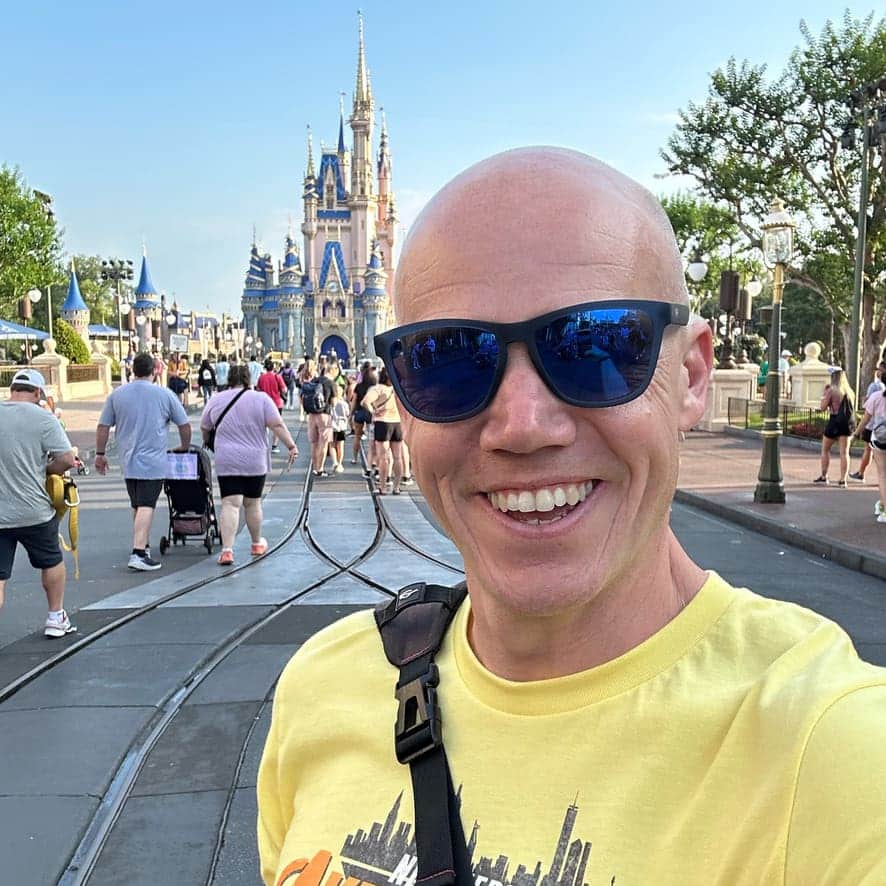
Meet the Author: Nate Bishop
I’m a die-hard Disney fan with 38 years of visits under my belt, having stepped into Disney World 120+ times. Proud to be a Disney Annual Passholder, a Vacation Club member since ’92, a Castaway Club Member, and a runDisney enthusiast. Oh, and I’ve graduated from the Disney College of Knowledge. Need Disney insights or planning tips? I’m your guy!
LAST UPDATED: