

Imagine Olaf remembering your kid’s name from twenty minutes ago. That’s roughly what this patent is for.
Disney has secured a patent for technology that gives AI-powered virtual characters a working memory — letting park robots recall details from earlier in a conversation instead of resetting with every interaction.
Quick Summary
- Patent US 12,718,481 B2, granted August 25, 2026
- Held by Disney Enterprises and ETH Zürich
- Filed May 22, 2024, tracing to a May 2023 provisional
- Characters draw on a bank of stored “memories” before replying
- It includes an actual mathematical formula for forgetting
- The patent names theme parks as an example setting
- Characters can also start conversations on their own

Who’s Behind It
The patent was granted to Disney Enterprises and ETH Zürich. The lead inventors are Erika Varis Doggett, Fabian Jonas Landwehr, and Romann Matthew Weber.
The ETH Zürich partnership is worth noting. It’s one of the world’s leading technical universities, and Disney Research has maintained a long-running collaboration with it. This isn’t a speculative filing from a marketing department — it’s an academic research partnership producing granted patents.
The Problem It Solves
The patent addresses a specific and well-known failure mode: chatbot-style characters tend to “hallucinate,” saying things that don’t match their personality or backstory.
This system fixes that by pulling from a bank of stored “memories” before generating a response.
Why That Matters More for Disney Than for Anyone Else
Being direct about the stakes here, because they’re unusually high for this particular company.
A general-purpose assistant that says something wrong is an inconvenience. A Disney character that says something wrong is a brand problem.
Disney’s characters are among the most tightly controlled intellectual property in existence. Cast members playing face characters train extensively on what their character would and wouldn’t say. The entire performance discipline exists to prevent exactly the kind of drift a language model produces by default.
Letting an AI-driven Olaf improvise freely is commercially unacceptable. Grounding every response in retrieved, verified facts about the character is the only version of this that Disney could plausibly deploy.
How the System Works
According to the patent, the process runs:
- A user sends a message to the virtual character
- The system matches that message to relevant memories tied to the character
- Those memories get ranked by relevance, recency, and importance
- A machine learning model uses the selected memories, plus a character description and chat history, to generate a response
- The reply gets sent back to the user
The memories come from “knowledge sources” — the patent lists articles, books, scripts, character descriptions, storyboards, and conversation logs with past users. These get broken into chunks and converted into discrete facts the system can search and retrieve.
Scripts and storyboards as source material is the key detail. It means the character’s knowledge is bounded by what the character actually knows in its own fiction, rather than by everything on the internet.
The Forgetting Formula
This is the genuinely novel part.
The patent includes an actual mathematical formula for how a character “forgets” over time.
Each memory has a stability value and a decay constant, and the system calculates a retention score determining whether the character can still recall it.
- Memories from trusted sources can be set to resist forgetting
- Memories from casual interactions fade faster if they’re not accessed again
Why Build Forgetting Deliberately
Counterintuitive at first — you’d think perfect recall is the goal. It isn’t, for three reasons.
Perfect recall is unsettling. A character that remembers every detail of a conversation from six months ago, verbatim, reads as surveillance rather than charm. Human-like memory decay makes an interaction feel like a relationship instead of a database lookup.
It’s also a practical necessity. A character interacting with thousands of guests daily cannot retain everything indefinitely. Some mechanism has to prioritise and discard.
And it’s a privacy control. A tunable decay constant means guest-volunteered details can be set to fade quickly by design, while canonical character facts persist. That’s a meaningful architectural choice, though the patent describes a capability rather than a policy.
The distinction matters. Disney has patented the ability to forget. Whether it configures systems to forget guest data promptly is a separate question nobody has answered.
Where This Could Show Up
The patent describes several formats: chatbots, characters inside a virtual world or game, and interactive robots in real-world settings.
The document specifically names “a theme park, store, home, etc.” as an example setting for an interactive robot.
That lines up with what Disney is already deploying:
- Olaf is heading to Disney’s Hollywood Studios in The Magic of Disney Animation
- Disneyland Paris recently introduced an interactive walk-around Olaf character
- Star Wars BDX droids have appeared at several Disney parks worldwide
These are exactly the kind of real-world interactive robots the patent describes. The memory system points to where that technology goes next: characters that hold onto details from your conversation instead of resetting each time.
Characters That Start Conversations
The system isn’t limited to responding.
The patent describes a “trigger” function letting a virtual character start a conversation on its own — for example, after a period of user inactivity.
The character can:
- Bring up an unfinished topic
- Ask a follow-up question
- Reference something from earlier in the conversation
This is the feature most likely to feel like magic in a park setting, and the one most likely to feel intrusive if calibrated badly.
A BDX droid that rolls up and references something you said ten minutes ago is a genuinely remarkable guest moment. A droid that does it to someone who has walked away is a different experience entirely.
Execution will decide which one it is.
The Standing Caveat
A granted patent is not a product. Disney holds an enormous portfolio of granted patents that never reached the parks.
That said, this one has more supporting evidence than most. Disney is already operating interactive character robots in multiple parks, this patent is granted rather than merely filed, and it comes from an established research partnership rather than a speculative internal filing.
The infrastructure it improves already exists. That makes deployment more plausible than for a patent describing something Disney has never built.
This is the third Imagineering patent to surface in recent weeks, alongside filings on projecting images onto smoke and fireworks residue and warning riders about personal aversions mid-attraction.
The Bottom Line
Disney and ETH Zürich have been granted a patent for giving AI virtual characters a working memory, grounding responses in retrieved facts from scripts, books, and past conversations to stop characters from saying things they shouldn’t.
It includes a mathematical forgetting formula with tunable decay, and a trigger function letting characters start conversations unprompted.
The patent names theme parks explicitly — and Disney already has Olaf and BDX droids in the field.
20% Off site-wide, plus Free Shipping on all orders of $65+
Over 75+ Designs! Your next park shirt is just a click away
Looking To Book Your Dream Disney Vacation?
Your Disney vacation should create unforgettable memories that last a lifetime.
Whether you’re a first-time Disney vacationer or looking to plan your next magical adventure, it isn’t enough just to go on a Disney vacation. We want you to talk about your vacation for years to come and create memories you’ll cherish forever. Vacation is calling! Are you ready to answer?


Meet the Author: Nate Bishop
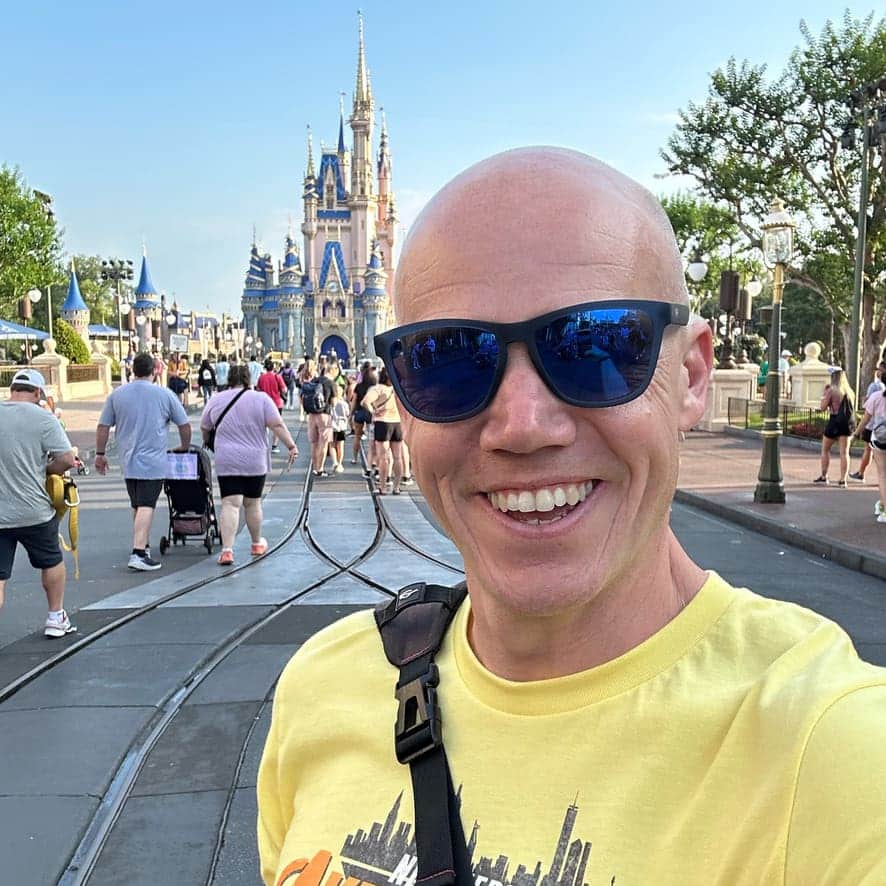
I’m a die-hard Disney fan with 38 years of visits under my belt, having stepped into Disney World 120+ times. Proud to be a Disney Annual Passholder, a Vacation Club member since ’92, a Castaway Club Member, and a runDisney enthusiast. Oh, and I’ve graduated from the Disney College of Knowledge. Need Disney insights or planning tips? I’m your guy!
LAST UPDATED: